
Polk County Previous Resident Sources
No single roll identifies every person tied to a Polk County address. The right source depends on the date and whether the goal is an owner, an occupant, or the physical history of the lot. Current parcel records establish the legal anchor. Recorded deeds then carry that anchor backward through named buyers and sellers. Directories and census schedules shift the focus from title to the household that was present. Maps, permits, newspapers, probate files, and obituaries fill the gaps.
| Source | Years It Covers | Where Held | What It Shows |
|---|---|---|---|
| Recorder real-estate index | 1992 to present online | Polk Record Room | Parties, dates, deed kind, property remarks, book/page or file |
| Early deed and town-lot books | Listed from 1846 or 1848, depending on series | Recorder, Imaging/Microfilm, SHSI | Owners, legal land descriptions, mortgages, plats and transfers |
| Des Moines directories | Digitized 1866-1922; microfilm 1866-1935 | Des Moines Public Library | Residents, occupations, household notes and addresses |
| Federal census | Public schedules through 1950 | National Archives and library databases | Household members, ages, relationships and residence |
| Sanborn and county maps | Including Des Moines 1891 and Polk atlases of 1872, 1885 and 1895 | Library of Congress and University of Iowa | Footprints, lots, landowners and period street context |
| Probate and newspapers | Probate files listed from 1846; newspaper runs vary | SHSI, court clerk and DMPL | Heirs, executors, last addresses, deaths and later moves |
For a recent transfer, begin online. For an address before 1992, expect a phone call, counter visit, or archive request. If ownership is already known but occupancy is not, move to the address section of a directory and then a nearby census year. Treat each date as a checkpoint. A deed date proves a recorded transfer, while a directory entry only reports what its publisher gathered for that edition.
Anchor Polk County Address History
The Polk County Assessor property search is the cleanest present-day starting point. Search a full or partial street address, then record the parcel or geoparcel number, owner, situs address, legal description, jurisdiction, and transfer book, page, or date when shown. The situs address is the property's location. The mailing address is where the tax notice goes, so it may point elsewhere and does not prove that the owner lives in the house.
Legal descriptions survive many changes that defeat a plain address search. A lot and subdivision, or township, section, and range description, can connect a modern parcel to an older deed even if a road name, house number, or municipal label changed. Compare the Assessor card with the Polk County GIS viewer. The map supplies parcel geometry, surrounding lots, historic imagery, zoning, contours, and other spatial layers. It supplies context, not proof of occupancy.
Note: A Des Moines mailing city, school district, ZIP code, and municipal boundary may describe different geographies around the same parcel.
Trace Polk County Past Owners
The Polk Record Room provides a free guest index for real-estate records from 1992 forward. Its simple search accepts party name, property, book/page, or file number. Expanded Search adds two names with And/Or logic, party roles, property text, date limits, remarks, phrase quotes, and a trailing asterisk wildcard. Those controls matter when several Polk County residents share a surname.
- Copy the current owner, legal description, parcel number, and transfer reference from the Assessor card.
- Find that owner's purchase deed by name, property terms, book/page, or file number. Confirm the deed kind, dates, parties, and legal remark.
- Identify the seller. Search that seller as the buyer on an earlier document, using Party One and Party Two carefully because roles vary by instrument.
- Repeat the sequence. Keep a dated log of each document rather than relying on a portal result order.
- At the 1992 boundary, contact Polk Recorder Imaging/Microfilm at 515-286-3175 and continue in older indexes or archival books.
- Grantor
- The person or entity giving or selling an interest in the property.
- Grantee
- The person or entity receiving or buying that interest.
- Chain of title
- The linked series of recorded transfers for one piece of land.
- Legal description
- The lot, subdivision, or survey wording that identifies land more reliably than a street address.
Beyond Polk County's Online Cutoff
A blank Record Room search before 1992 is a portal limit, not proof that no record exists. The Polk County Recorder search page directs older work to Imaging/Microfilm. The office is at 111 Court Avenue, Suite 250, Des Moines, and its real-estate line is 515-286-3160. Iowa Land Records offers a separate statewide account route, while the State Historical Society of Iowa and some FamilySearch collections extend the archive path.
The State Historical Society Polk County inventory separates land deeds, town-lot books, mortgages, sheriff's deeds, tax-sale deeds, and plats. Its listed runs include land deeds and indexes from 1848, town-lot indexes from 1851, tax-sale deeds from 1864, and sheriff's deeds from 1872. One displayed land-record range reads “1846-1826,” an impossible reverse span. Do not silently repair it. Ask the archive to verify the catalog entry before using it as a date claim.
The archive route is part of Polk County's record geography. Early records may describe Fort Des Moines, a township and range, a town lot, or a subdivision rather than today's address. County organization and boundary adjustments in the 1840s and 1850s add another reason to search by land description and date.
Map Previous Polk County Homes
Ownership papers do not show whether the building had the same shape throughout the deed chain. The Library of Congress 1891 Des Moines Sanborn set contains 49 sheets that can show street names, lot context, building footprints, additions, and outbuildings for covered areas. The University of Iowa's county-atlas holdings add Polk volumes for 1872, 1885, and 1895, useful for rural landowner and road context.
The Iowa historical collections page also provides a broader route into maps, manuscripts, and ephemera connected with Polk County places.
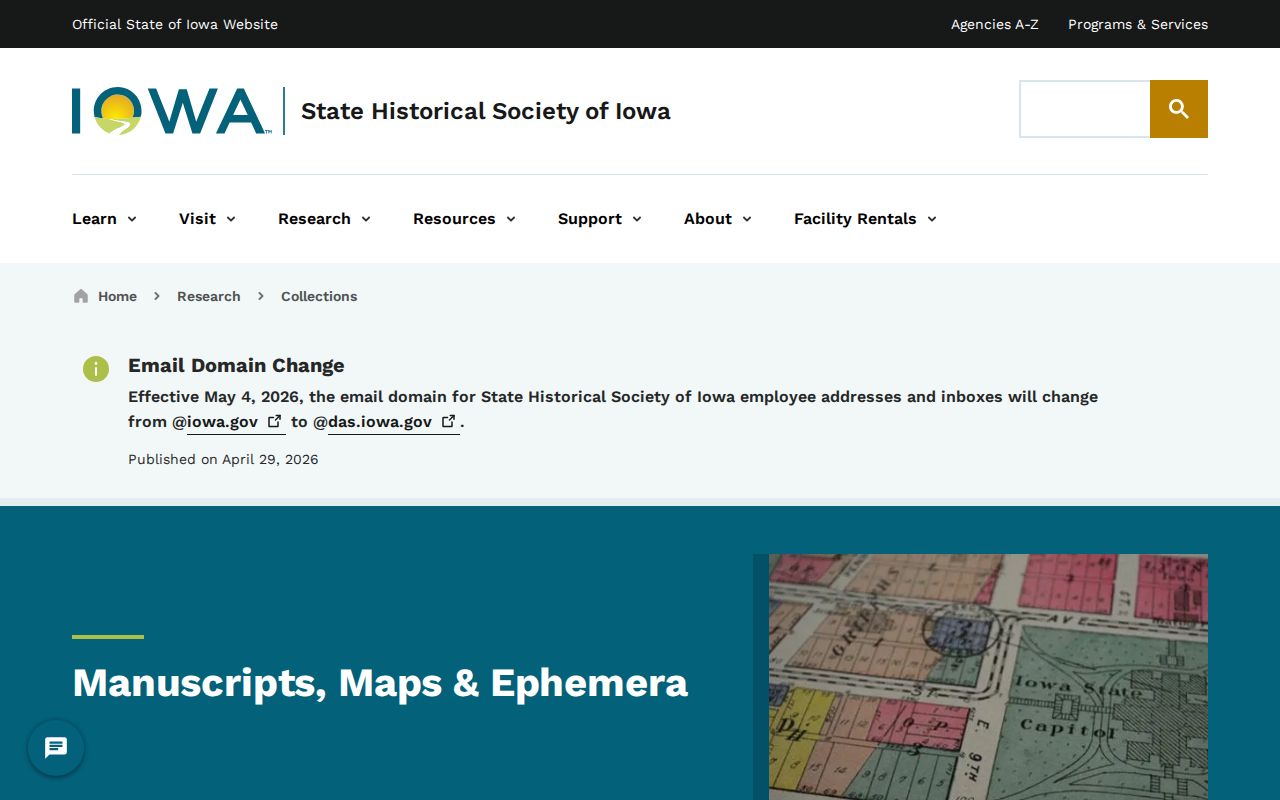
Use a map to test whether the structure, lot, or road existed in the period under study. It cannot name every past resident. Pair it with a deed, directory, census schedule, permit, or newspaper item from the same era.
Library Help for Previous Residents
Des Moines Public Library is the strongest human fallback when OCR fails or a directory year is not online. Its Premium Research Services accepts a focused request about a person, topic, or event. A useful house-history request supplies the address, variant street names, parcel or subdivision, a tight date range, known surnames, and the exact record sought. No separately titled house-history guide was found, so describe the service accurately instead of promising a dedicated guide.

The service can bridge directory microfilm, newspaper indexes, local books, oral histories, and digitized collections. Central Library at 1000 Grand Avenue is the physical fallback. A librarian can help locate a volume or index, but the request still needs a defined address and period.
Recover Polk County Past Households
Owners are only half the story. Des Moines directories can name boarders, renters, spouses, occupations, and the person associated with a street address. Digitized scans cover 1866-1922, microfilm covers 1866-1935, print runs start in 1910, and telephone books begin in 1957. The historical collections themselves are detailed on the Polk County city directory page. Use the street and avenue guide when the address is known, then verify the matching alphabetical entry.
- Copy the name, initials, occupation, household notation, and address exactly as printed in one directory year.
- Check the prior and next available volumes. A missing digitized year means “not located in that run,” not that the household vanished.
- Pair the directory with public federal census years such as 1870, 1880, 1900, 1910, 1920, 1930, 1940, and 1950.
- Use census ages and relationships to distinguish same-name households, then return to later directories to follow moves.
When a trail ends, the DMPL newspaper and obituary index, cemetery records, and probate files can explain a death or estate transfer. SHSI lists Polk probate case files from 1846-1914 and a probate index from 1850-1912. Search a spouse, executor, heir, street, or institution as well as the main surname. An obituary's address remains a dated claim that should be checked against another source.
Lawful use. Polk County previous-resident research is appropriate for house history, genealogy, estates, and personal curiosity. Never use an old or current address to track, harass, or harm a living person.
Write the final timeline with source labels: owner of record, directory resident, census household, obituary address, or map evidence. Those labels prevent an owner from being mistaken for an occupant and keep uncertain links visible.