
Finding Polk County Residents
Start with the fact already in hand. A street address points to the Polk County Assessor and the county GIS map. A party name or deed reference belongs in the Recorder's Record Room. Case questions go to Iowa Courts Online. Older names and addresses live in the Des Moines Public Library or the State Historical Society of Iowa. That sequence keeps a residents directory search tied to records with a clear custodian and date.
Each source proves only what it records. An assessor card names an owner and a tax mailing destination, not every occupant. A voter match confirms registration details the voter entered, never a household roster. A deed names the parties to one instrument. A city directory reflects a single year of the publisher's canvass. Compare two or more independent identifiers. Do that before deciding two entries describe the same Polk County resident.
- Search the Assessor by owner, street, parcel, or jurisdiction.
- Record the situs address, mailing address, parcel, and transfer reference.
- Check the Recorder by party, property, book and page, or file number.
- Use the voter, court, library, or archive source that matches the question.
- Call the custodian or make a Chapter 22 request when the web trail ends.
Polk County Directory Offices
Three county offices carry the current-record path. The Assessor maintains parcel, owner, mailing, value, zoning, and transfer data. The Recorder keeps deeds, mortgages, liens, plats, and other recorded instruments. The Auditor handles elections and voter-list products. Iowa's Secretary of State offers the individual registration check. Court files stay with the Polk County Clerk of District Court, not the Recorder. For an address-led sequence, use the Polk County street directory.
Polk County Recorder
111 Court Avenue, Suite 250
Des Moines, IA 50309
515-286-3160
Polk County Assessor
111 Court Avenue, Room 195
Des Moines, IA 50309
515-286-3014
Polk County Elections Office
120 Second Avenue, Suite A
Des Moines, IA 50309
515-286-3247
Polk Assessor Search Fields
The Assessor is the most flexible starting point for a current parcel. Its simple form takes a full or partial street address, parcel, last and first name, jurisdiction, or a Des Moines assessment district. Fill in at least one box, the page advises, and keep it lean. Less is better. Never put a city, state, or ZIP in the street-address box. That rule matters because a postal city and the parcel's taxing jurisdiction can differ.
| Field | Useful entry | Polk-specific caution |
|---|---|---|
| Street Address | House, street, range, or unit | No city, state, or ZIP |
| Owner | Last and first name | Owner does not prove occupancy |
| Parcel | Formatted or compact parcel ID | Several formats are accepted |
| Jurisdiction | City or township checkbox | Use it to narrow common streets |
| District | Des Moines district checkbox | Applies within the city search |
The general search adds plat, radius, and transfer book and page controls. It also covers value, class, school district, and township-range. Results can sit the situs and mailing fields side by side. Treat the mailing field as a contact clue only. Owners may receive tax mail somewhere other than the parcel.
Three Polk County Identifiers
Anchor a reliable Polk County residents directory entry to three local identifiers whenever possible. Use the situs street address. Use the parcel or geoparcel number. Add a Recorder reference such as book and page or a file number. Names change. Street spelling varies. A parcel and legal description form a steadier bridge from the Assessor card to the recorded deed.
Parcel: the Assessor's unit of mapped property. Index: a finding aid pointing to a record. Roll: an official list kept for a public task. Criss-cross directory: a historical directory arranged by street or phone as well as name.
For a same-name search, take the parcel or book-page route before widening the query. The Recorder's expanded form can join two names with And or Or. It distinguishes Party One from Party Two. It also searches names that begin with a phrase. And it opens separate name or property directories. Those controls keep one Polk County resident from being merged with another.
Polk Recorder Starts in 1992
The current Record Room provides online real-estate index records from 1992 forward. Its simple search switches among all fields, party name, property, book and page, and file number. Date filters, party roles, phrase quotes, and a trailing wildcard tighten the results. A deed index entry may show the instrument type, parties, dates, legal remarks, and recording reference. It still does not say who sleeps at an address today.
Earlier land work follows a different route. Call Imaging/Microfilm at 515-286-3175, visit the Recorder counter, or consult the State Historical Society inventory and related microfilm. The historical holdings separate land deeds, town lots, mortgages, plats, sheriff's deeds, and tax-sale deeds. A blank Record Room search before 1992 is a cutoff, not proof that no transfer exists.
The Polk Record Room guest-search page displays the current search surface. Its fields lead a reader toward an indexed document, and the original image or office copy supplies the context.
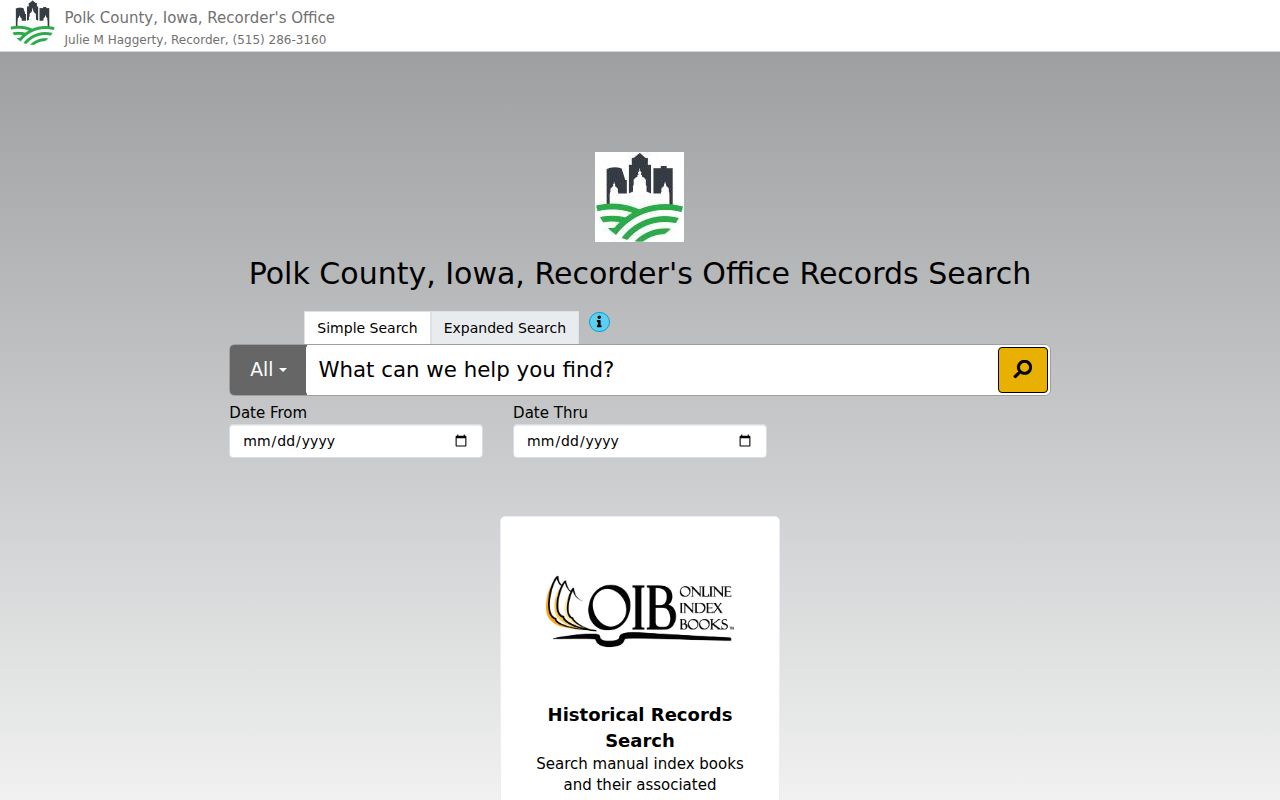
The visible search choices make party, property, and recording references separate paths. That helps when a name alone returns too much.
Current Polk County Directories
Every current source that lists Polk County people exists for a simple reason. An office does a particular job. Property rolls maintained by the Assessor show owners and mailing names. The Recorder indexes parties to recorded instruments. Voter lookup confirms one registration from details someone submits. Iowa Courts Online names parties in public cases. Civic tools from cities publish leaders and contacts rather than whole memberships. Piece by piece they can power a careful resident lookup. Yet none of them alone forms a complete residents directory.
| Source | Who It Lists | Keeper | Access |
|---|---|---|---|
| Assessor property roll | Owners and mailing names | Polk Assessor | Free search |
| Voter registration check | One registered voter | Iowa SOS | Submitted name and ZIP |
| Record Room | Parties to recorded instruments | Polk Recorder | Online from 1992 |
| Iowa Courts Online | Parties in public cases | Iowa Judicial Branch | Basic public search |
| Neighborhood finder | Public civic contacts | City of Des Moines | Map and leader downloads |
Let the fact you need pick the source. A property question starts with the Assessor. A recorded transfer belongs to the Recorder. Registration checks go through the Secretary of State form. Court files begin at the judicial portal and end at the clerk. When the goal is one name traced across several systems, follow the Polk County resident lookup workflow and treat each result in context.
Polk County Voter Check
Iowa's public registration tool asks for a first name and a last name. It also wants a five-digit ZIP code. Enter those and it can confirm registration and polling details for that one voter. Hyphenated or two-part surnames may need alternate spelling, as the form itself warns. It is not a browseable list of the block. Ballot choices stay secret. For certified voter-file products, Iowa's election rules route requests through the Polk County Auditor. The Auditor sets its own permitted-use certification and fee schedule. Protected address programs can suppress or swap an address. Check the record of the person whose details you hold. Contact Elections when spelling, ZIP, or status needs fixing.
The official Iowa voter registration lookup appears below. Its narrow input makes the point plainly. A registration check answers one question, not a broad directory query.
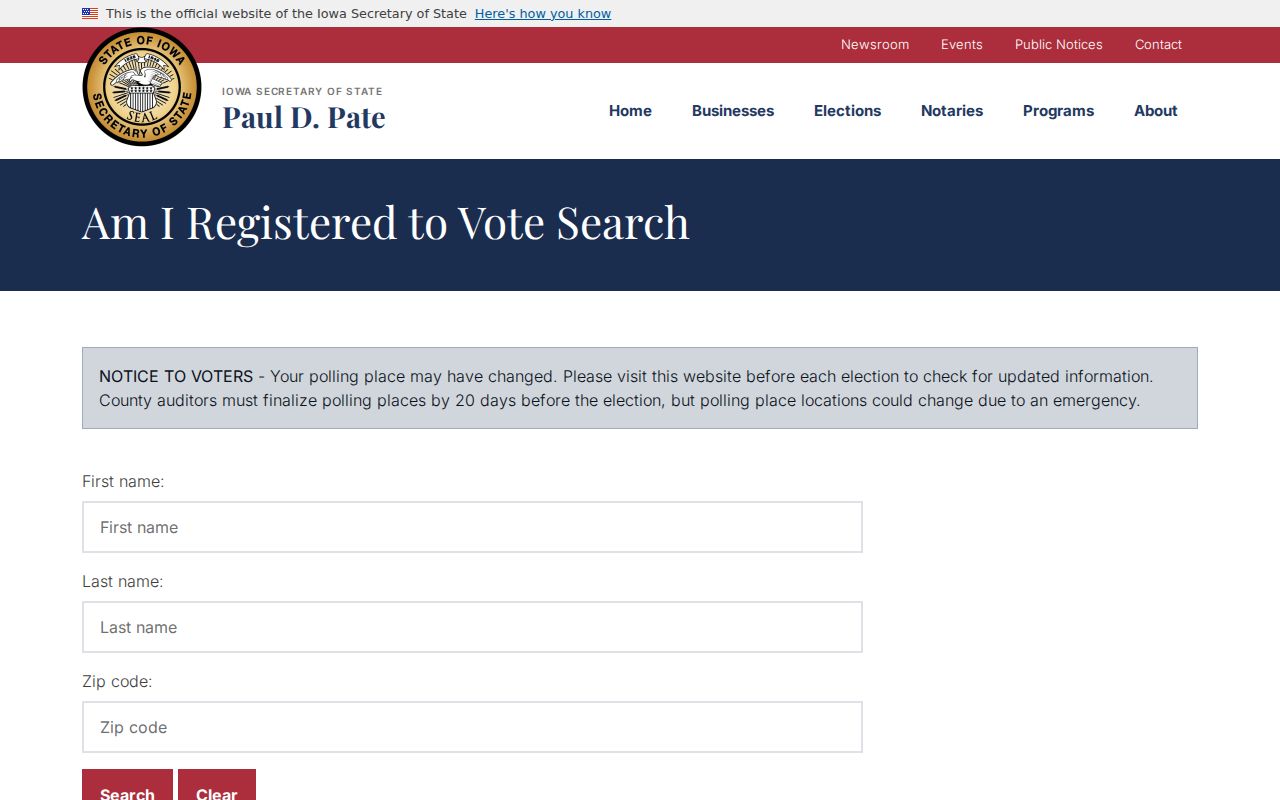
Match the submitted name and ZIP with care. If an official result conflicts with a recent registration, take it to the county election office.
Polk Court Results in Context
Iowa Courts Online is the public name-search route into state trial cases. Electronic coverage runs strongest after 1998. Earlier years vary. A hit can display a case number, county, title, parties, and filing data. Charges, events, and disposition also appear where public. Charges and filings are not a final outcome, so keep them distinct. Older files, certified copies, and restricted details go through the Polk County Clerk of District Court at 500 Mulberry Street, Room 212. Anything missing online goes there too. Civil, probate, and family work ties to the historic courthouse. Criminal functions sit in separate county facilities. Give the clerk a case number, party, record type, and date range. The Recorder does not hold divorce case files.
The Iowa Courts Online search page is the statewide entry point. Read the county and case number before treating a same-name result as a Polk match.
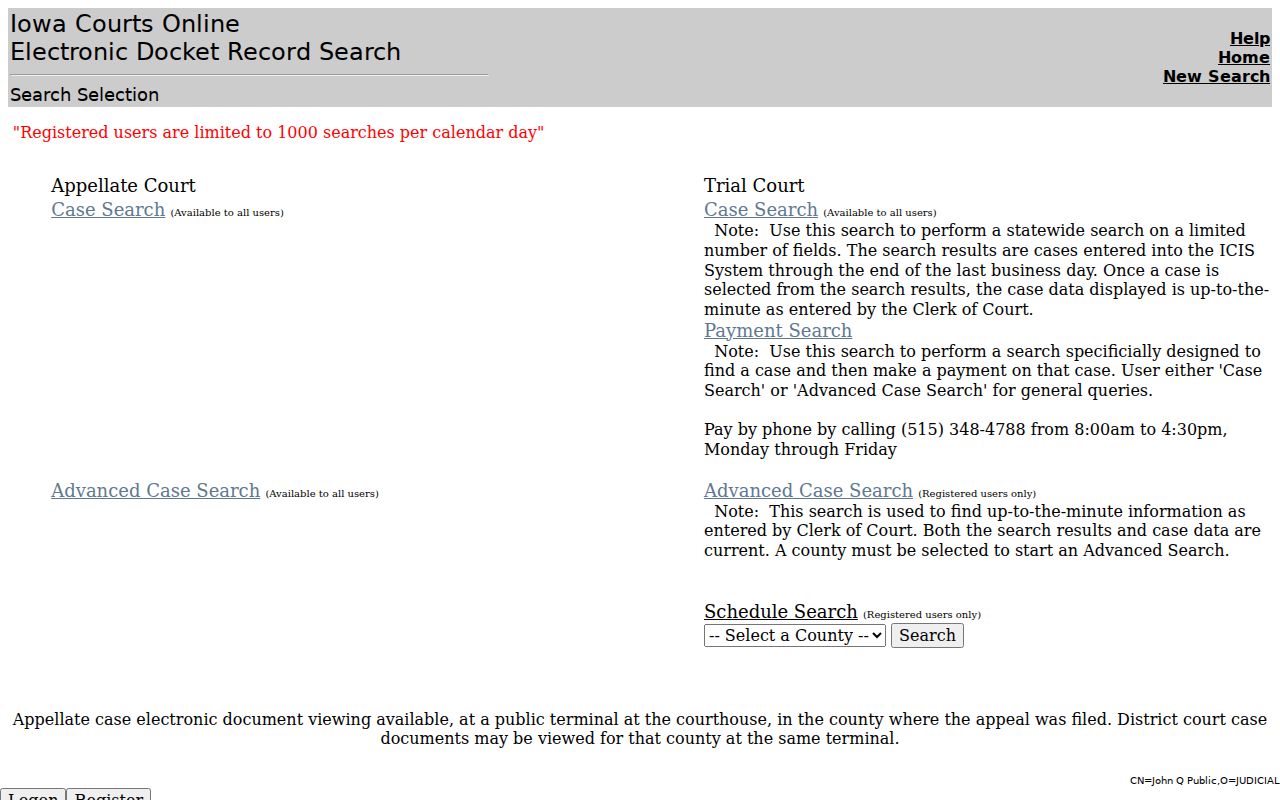
The portal is only an index. The clerk stays the source for the official file and copy options. The separate Iowa Sex Offender Registry is an official safety resource with its own terms and statutory scope.
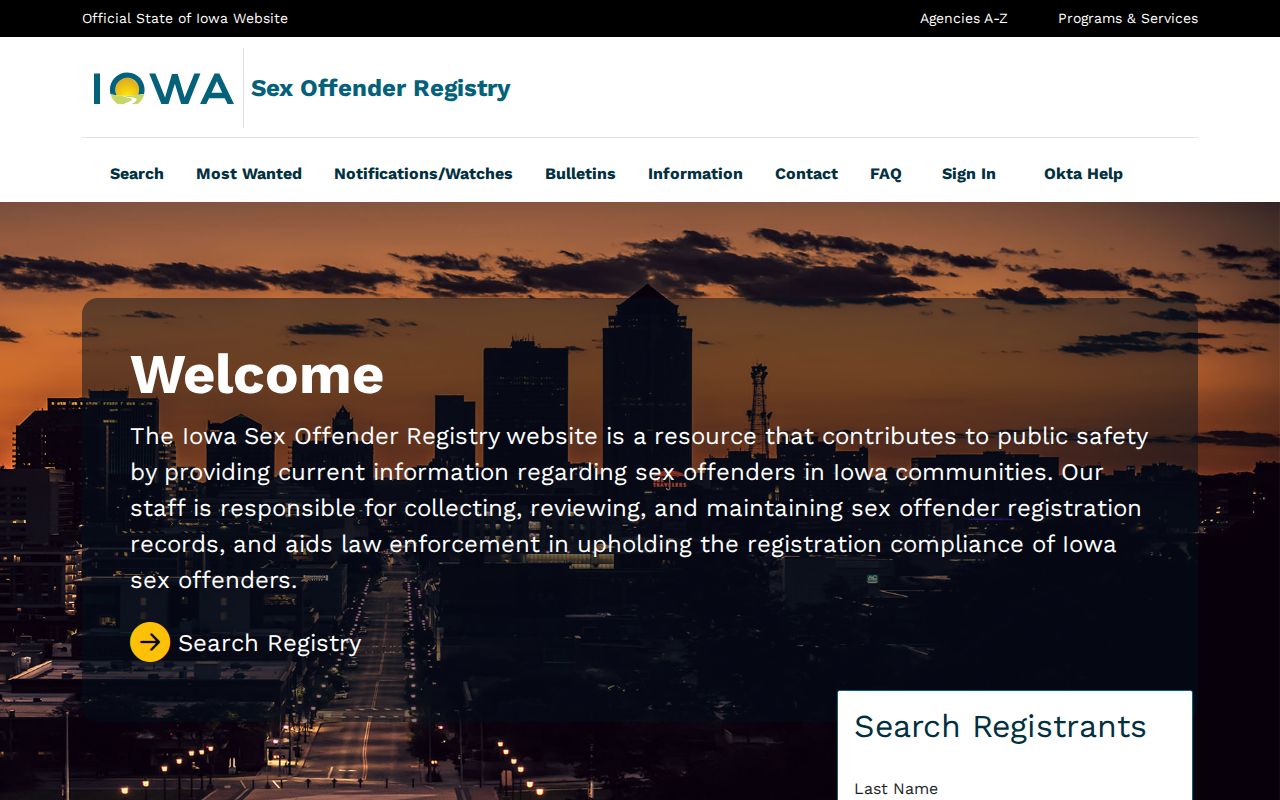
A registry entry carries only the meaning Iowa law assigns it. Never stretch it into a broader claim about a person or household.
Historical Polk County Directories
Des Moines Public Library holds the county's deepest city directory collection. Its directory page reports digitized volumes from 1866 through 1922. Microfilm runs from 1866 through 1935. Print directories date from 1910 forward. One library description starts the digital range at 1860, so verify your target year with staff rather than guessing through the discrepancy. Phone books begin in 1957. The State Historical Society adds early county, probate, deed, naturalization, map, and manuscript holdings. A single entry may carry a name, spouse, trade, street address, and an owner or renter mark. When the name is unknown, a street guide reverses the search. The 1909 R.L. Polk volume counted 47,983 names. It canvassed territory beyond the corporate line. That is a publisher figure describing that edition's reach rather than any modern count. The full shelf, publisher sequence, and entry method are laid out in the Polk County city directory.
When Polk Online Records Stop
Online gaps are normal in Polk County. Pre-1992 deeds live in Recorder Imaging and Microfilm plus archive collections. Pre-1998 court questions usually need the county clerk. Directory years outside the digital run may still exist on microfilm or in print, and older permit or city files may call for the Des Moines public-record request form. A failed web query should open the next access channel, never close the question.
| Stopping point | Next channel | What to provide |
|---|---|---|
| Recorder before 1992 | Imaging/Microfilm or SHSI | Names, legal description, date span |
| Older court file | Polk clerk counter or phone | Party, case type, approximate year |
| Missing directory year | DMPL Central Library | Name, address, target years |
| Older city project | Des Moines Chapter 22 request | Address, permit or project terms, dates |
| Early county series | State Historical Society | Record series and catalog span |
Iowa Code Chapter 22 gives every person the right to examine and copy public records. Another law may make certain records confidential. It does not make an office build a new resident report. Nor must anyone answer a research question for you. A focused request works best. It should name an existing record, a date range, and an identifier. That is the request most likely to reach the right custodian.
Protected Polk County Addresses
Some systems lawfully hide or substitute addresses. Iowa's Safe at Home program gives eligible survivors a substitute address, and election and land-record protections can also shape what appears for protected people. Sealed cases, juvenile files, victim information, vital certificates, adoption material, and confidential voter details all sit outside any general residents directory.
Use records lawfully. Confirm facts with the custodian, respect protected addresses, and never use a public record to stalk, harass, threaten, or harm a person.
Corrections belong with the office that keeps the record. That rule keeps fixes fast. Parcel disputes go to the Polk County Assessor. Deed-index problems go to the Recorder, and docket errors go to the clerk. Registration mistakes belong with the Auditor or Secretary of State, while vital-record amendments go to Iowa HHS or the local registrar, since tying each correction to a single record helps the office act quickly.
Polk Records Changed in 2026
Change is sweeping Polk County records. The Assessor is moving from a long-running in-house system to Vanguard Appraisals. A new site is planned for 2026. Search access continues through the transition. The Recorder has rolled out the current Record Room search plus PropertyCheck. PropertyCheck sends a notice when a recorded name matches the enrolled one. The notice is not proof of ownership or fraud. Expect bookmarks and screen labels to shift as these projects settle.
The modernization also has impressive scale. The Polk Auditor has digitized more than a century of Board minutes. It has also digitized 84,300 transfer-index pages. Even so, home access has limits. The Recorder's 1992 web boundary, the court system's mostly post-1998 electronic coverage, and the library's mix of digital, microfilm, and print directories still shape the practical route for any city directory or resident lookup.
Date every result and save the official landing page with it. If a saved deep link fails, return to the county department page instead of an unsourced copy. Note the card date and parcel for an Assessor card. Keep the file or book-page reference for a deed. For a docket, hold onto the case number and county. Those small habits keep a Polk County residents directory search working through any redesign.