
Finding Polk County Residents
Begin with the fact you already have. A street address fits the Polk County Assessor and county GIS. A party name or deed reference fits the Recorder's Record Room. A case question belongs in Iowa Courts Online, while an old name or address belongs in the Des Moines Public Library collection or the State Historical Society of Iowa. This sequence keeps a residents directory search tied to records that have a clear custodian and date.
Each source proves only what it records. An assessor card identifies the owner and tax mailing destination, not every occupant. A voter match confirms registration details entered by the voter, not a household roster. A deed names parties to an instrument. A city directory reflects the publisher's canvass in one year. Compare two or more independent identifiers before deciding that two entries describe the same Polk County resident.
- Search the Assessor by owner, street, parcel, or jurisdiction.
- Record the situs address, mailing address, parcel, and transfer reference.
- Check the Recorder by party, property, book and page, or file number.
- Use the voter, court, library, or archive source that matches the question.
- Call the custodian or make a Chapter 22 request when the web trail ends.
Polk County Directory Offices
Three county offices form the main current-record path. The Assessor maintains parcel, owner, mailing, value, zoning, and transfer data. The Recorder keeps deeds, mortgages, liens, plats, and other recorded instruments. The Auditor handles elections and voter-list products, while Iowa's Secretary of State provides the individual registration check. Court files remain with the Polk County Clerk of District Court, not the Recorder. For a full address-led sequence, use the Polk County street directory.
Polk County Recorder
111 Court Avenue, Suite 250
Des Moines, IA 50309
515-286-3160
Polk County Assessor
111 Court Avenue, Room 195
Des Moines, IA 50309
515-286-3014
Polk County Elections Office
120 Second Avenue, Suite A
Des Moines, IA 50309
515-286-3247
Polk Assessor Search Fields
The Assessor is the most flexible starting point for a current parcel. Its simple form accepts a full or partial street address, parcel, last and first name, jurisdiction, and a Des Moines assessment district. The page advises users to fill in at least one box and says less is better. Do not place a city, state, or ZIP in the street-address box. That rule matters because a postal city and the parcel's taxing jurisdiction can differ.
| Field | Useful entry | Polk-specific caution |
|---|---|---|
| Street Address | House, street, range, or unit | No city, state, or ZIP |
| Owner | Last and first name | Owner does not prove occupancy |
| Parcel | Formatted or compact parcel ID | Several formats are accepted |
| Jurisdiction | City or township checkbox | Use it to narrow common streets |
| District | Des Moines district checkbox | Applies within the city search |
The general search adds plat, radius, transfer book and page, value, class, school district, and township-range controls. Results can expose situs and mailing fields side by side. Treat the mailing field as a contact clue only. Owners may receive tax mail somewhere other than the parcel.
Three Polk County Identifiers
A reliable Polk County residents directory entry should be anchored to three local identifiers when possible: the situs street address, the parcel or geoparcel number, and the Recorder reference such as book and page or file number. Names change. Street spelling varies. A parcel and legal description create a steadier bridge from the Assessor card to the recorded deed.
Parcel: the Assessor's unit of mapped property. Index: a finding aid that points to a record. Roll: an official list kept for a public task. Criss-cross directory: a historical directory arranged by street or phone as well as name.
For a same-name search, use the parcel or book-page route before widening the query. The Recorder's expanded form can join two names with And or Or, distinguish Party One from Party Two, search names that begin with a phrase, and open separate name or property directories. These controls help keep one Polk County resident from being merged with another.
Polk Recorder Starts in 1992
The current Record Room provides online real-estate index records from 1992 forward. Its simple search switches among all fields, party name, property, book and page, and file number. Date filters, party roles, phrase quotes, and a trailing wildcard can tighten the result. A deed index entry may show the instrument type, parties, dates, legal remarks, and recording reference. It still does not say who sleeps at an address today.
Earlier land work follows a different route. Call Imaging/Microfilm at 515-286-3175, visit the Recorder counter, or consult the State Historical Society inventory and related microfilm. The historical holdings separate land deeds, town lots, mortgages, plats, sheriff's deeds, and tax-sale deeds. A blank Record Room search before 1992 is therefore a cutoff, not proof that no transfer exists.
The Polk Record Room screenshot below shows the current guest-search surface. Its fields lead a reader toward an indexed document, then the original image or office copy supplies context.
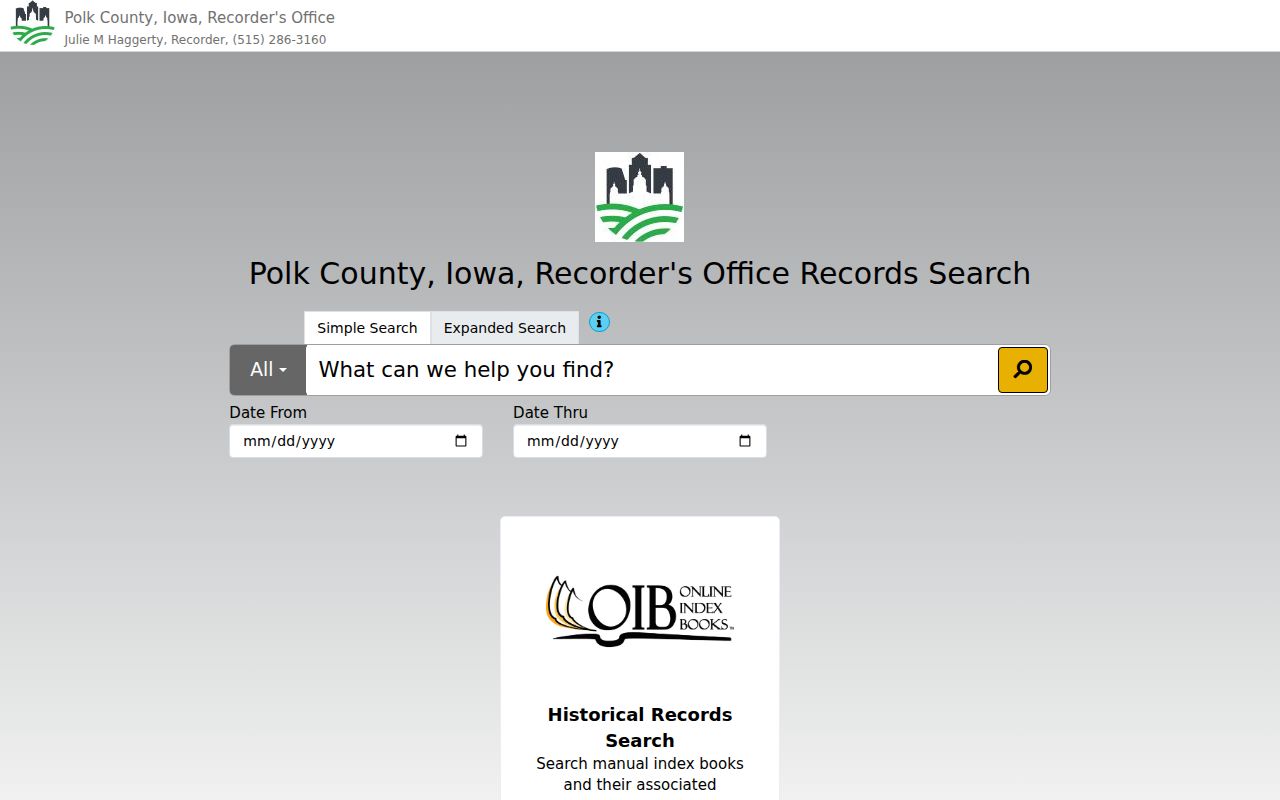
The visible search choices make party, property, and recording references separate paths, which is useful when a name alone returns too much.
Current Polk County Directories
Current public sources list people because an office performs a specific task. Property systems list owners and mailing names. The Recorder indexes parties to filed instruments. The voter lookup checks one registration from submitted details. Iowa Courts Online lists parties in public cases. City civic tools publish neighborhood leaders or public contacts, not all members. Together they can support a careful resident lookup, but they never form one complete roll.
| Source | Who It Lists | Keeper | Access |
|---|---|---|---|
| Assessor property roll | Owners and mailing names | Polk Assessor | Free search |
| Voter registration check | One registered voter | Iowa SOS | Submitted name and ZIP |
| Record Room | Parties to recorded instruments | Polk Recorder | Online from 1992 |
| Iowa Courts Online | Parties in public cases | Iowa Judicial Branch | Basic public search |
| Neighborhood finder | Public civic contacts | City of Des Moines | Map and leader downloads |
Choose the source by the fact it can confirm. A property question starts with the Assessor. A recorded transfer starts with the Recorder. A registration check uses the Secretary of State form. A court file uses the judicial portal and then the clerk. When the task centers on one name across several systems, follow the Polk County resident lookup workflow and keep each result in its proper context.
Polk County Voter Check
Iowa's public registration tool asks for first name, last name, and a five-digit ZIP. A successful response can confirm registration and polling information for the entered voter. The form warns that hyphenated or two-part surnames may need alternate entry. It is not a browseable block list, and ballot choices remain secret.
Certified voter-file products come through the Polk County Auditor under Iowa's election rules. The request has its own permitted-use certification and fee structure. Protected address programs can suppress or substitute an address. Use the public form to check the record of the person whose details are known, then contact Elections when spelling, ZIP, or status needs correction.
The official Iowa voter registration lookup is shown below. Its narrow input is a reminder that a registration check answers one question, not a broad directory query.
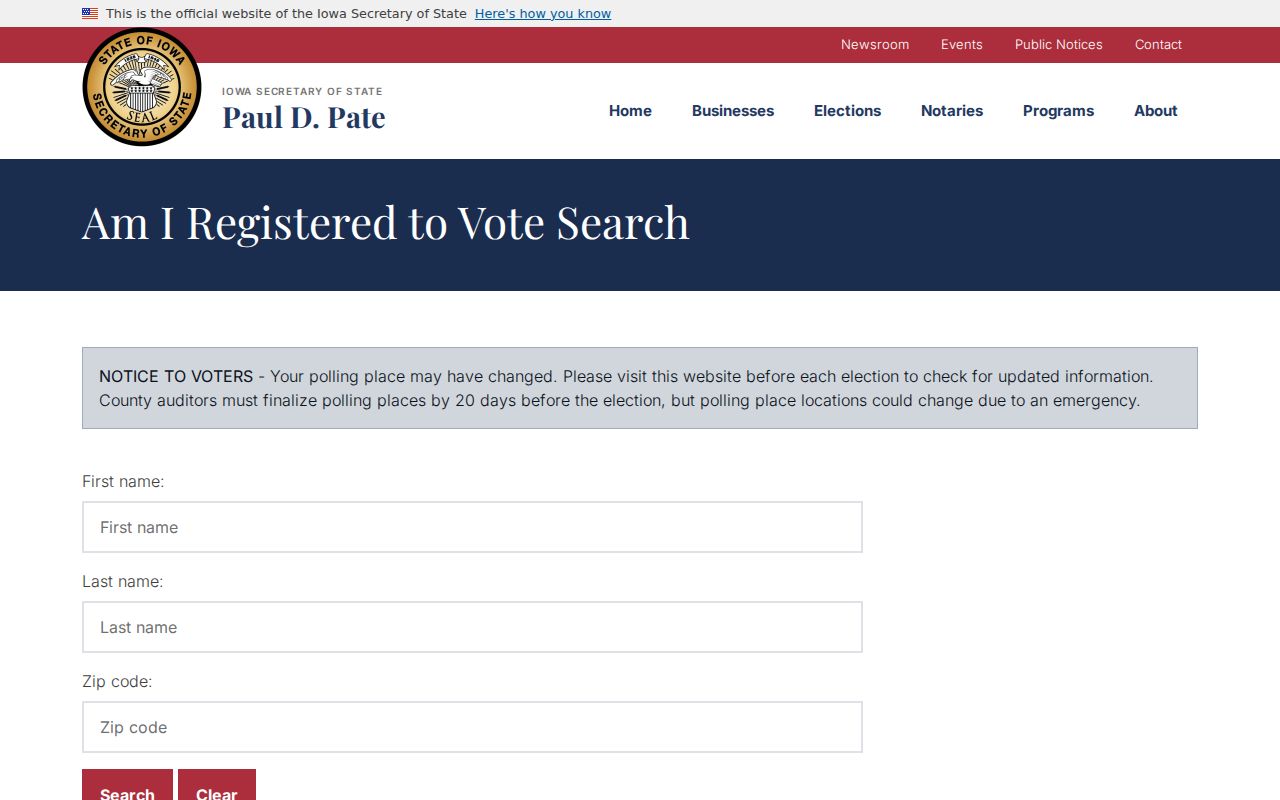
Match the submitted name and ZIP carefully, and use the county election office when the official result conflicts with a recent registration.
Polk Court Results in Context
Iowa Courts Online is the public name-search route for state trial cases. Public electronic coverage is generally strongest after 1998, with earlier coverage varying. A result can show a case number, county, title, parties, filing data, charges, events, and disposition information where public. Charges and filings must not be confused with a final outcome.
Older files, certified copies, restricted details, and records that do not appear online go through the Polk County Clerk of District Court at 500 Mulberry Street, Room 212. Civil, probate, and family work is tied to the historic courthouse, while criminal functions use separate county facilities. Give the clerk a case number, party, record type, and date range. The Recorder does not keep divorce case files.
The Iowa Courts Online search screenshot illustrates the statewide entry point. Read the county and case number before treating a same-name result as a Polk match.
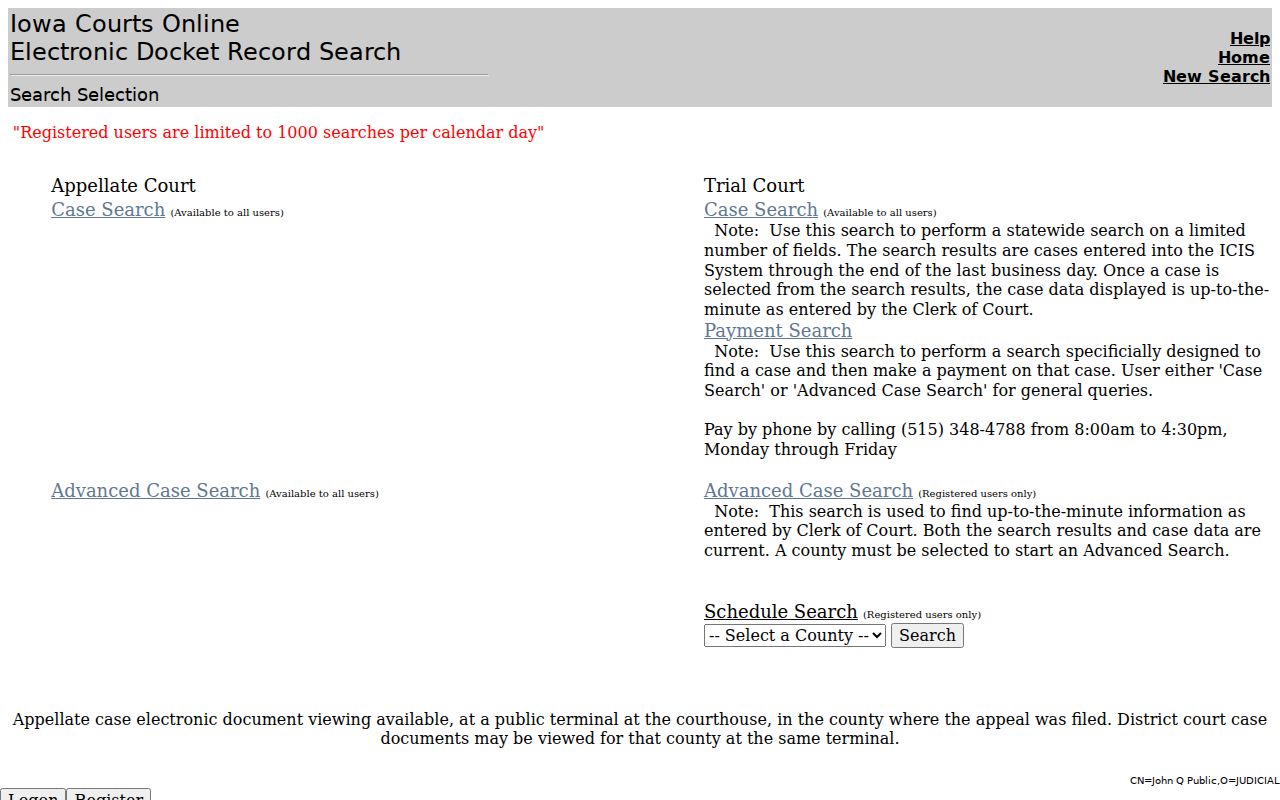
The portal is an index into court history, while the clerk remains the source for the official file and copy options.
The separate Iowa Sex Offender Registry is an official safety resource with its own terms and statutory scope.
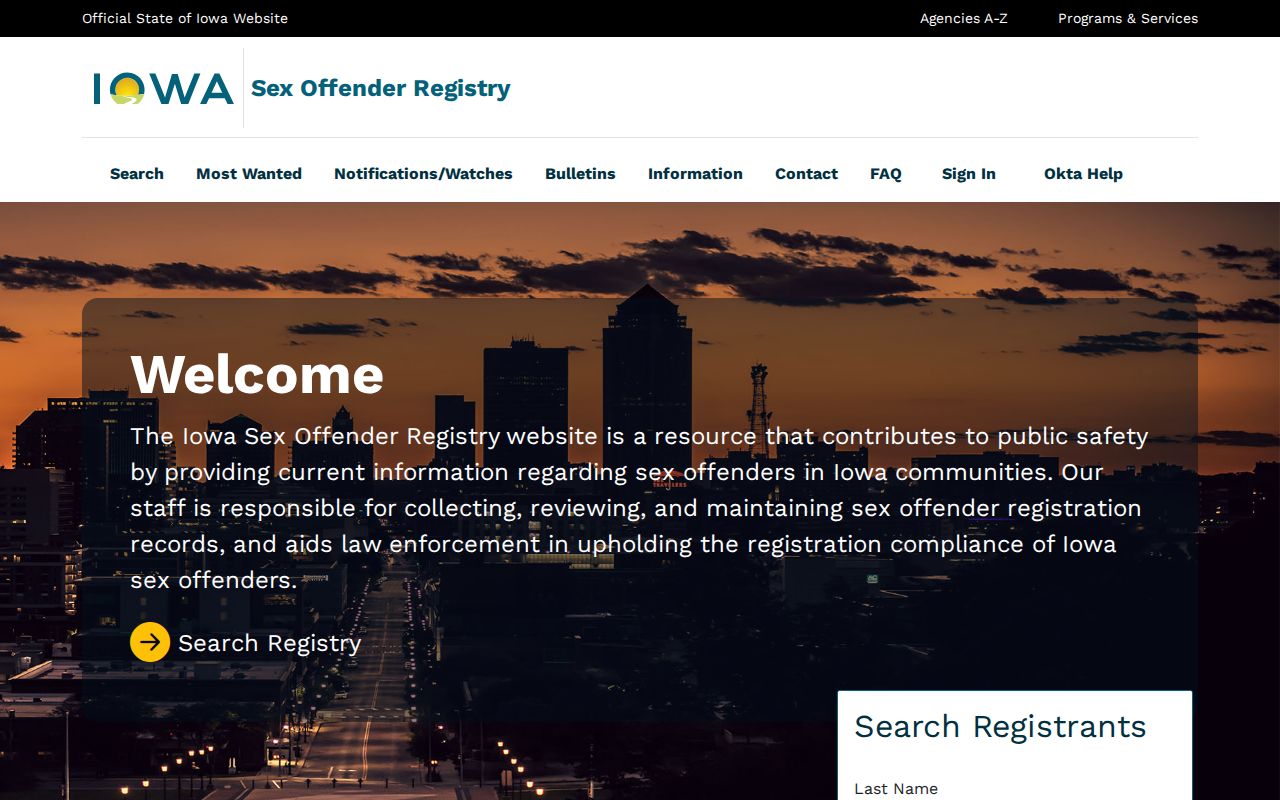
A registry entry has the limited meaning set by Iowa law and the official result. It should never be expanded into a general claim about a person or household.
Historical Polk County Directories
Des Moines Public Library preserves the county's strongest city directory run. Its directory page reports digitized volumes from 1866 through 1922, microfilm from 1866 through 1935, and print directories from 1910 forward. Another library description begins the digital range at 1860, so verify the desired year with staff instead of filling the discrepancy by guess. Phone books begin in 1957. The State Historical Society adds early county, probate, deed, naturalization, map, and manuscript holdings.
An entry may give a name, spouse, work or trade, street address, and owner or renter notation. A street guide can reverse the search when the name is unknown. The 1909 R.L. Polk volume says it counted 47,983 names and canvassed adjacent territory beyond the corporate line. Those publisher figures describe that edition's reach, not a modern population. The full shelf, publisher sequence, and entry method appear in the Polk County city directory.
When Polk Online Records Stop
Online gaps are normal in Polk County. Pre-1992 deeds move to Recorder Imaging/Microfilm and archive collections. Pre-1998 court questions often need the county clerk. Directory years outside the digital run may still exist on microfilm or in print. Older permit and city files may require the Des Moines public-record request form. A failed web query should trigger the next access channel, not a claim that no record exists.
| Stopping point | Next channel | What to provide |
|---|---|---|
| Recorder before 1992 | Imaging/Microfilm or SHSI | Names, legal description, date span |
| Older court file | Polk clerk counter or phone | Party, case type, approximate year |
| Missing directory year | DMPL Central Library | Name, address, target years |
| Older city project | Des Moines Chapter 22 request | Address, permit or project terms, dates |
| Early county series | State Historical Society | Record series and catalog span |
Iowa Code Chapter 22 gives every person access to examine and copy public records unless another law makes the material confidential. It does not require an office to create a new resident report or answer a research question. A focused request for an existing record, date range, and identifier is more likely to reach the right custodian.
Protected Polk County Addresses
Some public systems lawfully hide or substitute address information. Iowa's Safe at Home program serves eligible survivors through a substitute address. Election and land-record protections can also affect what appears for protected people. Sealed cases, juvenile files, victim information, vital certificates, adoption material, and confidential voter details remain outside a general residents directory.
Use records lawfully. Confirm facts with the custodian, respect protected addresses, and never use a public record to stalk, harass, threaten, or harm a person.
Corrections go to the office that owns the record. Send parcel evidence to the Assessor, deed-index issues to the Recorder, docket issues to the clerk, registration errors to the Auditor or Secretary of State, and vital-record amendments to Iowa HHS or the local registrar. Keeping the correction tied to one record helps the office act on it.
Polk Records Changed in 2026
Several live sources changed during the research period. Polk County announced continued Assessor search access during its move from a long-running in-house system to Vanguard Appraisals, with a new site planned in 2026. The Recorder also introduced the current Record Room search and PropertyCheck. PropertyCheck sends a notice when a recorded name matches the enrolled name, but the notice is not proof of ownership or fraud. Portal bookmarks and screen labels may shift as these projects settle.
The same modernization has a long local scale. The Polk Auditor reports that the office digitized more than a century of Board minutes and 84,300 transfer-index pages. Newer electronic access does not mean every historic image is searchable from home. The Recorder's 1992 web boundary, the court system's mostly post-1998 public electronic coverage, and the library's mix of digital, microfilm, and print directories still control the practical route.
Date each result and keep the official landing page with the record note. If a saved deep link fails, return to the county department page rather than switching to an unsourced copy. For an Assessor card, note the card date and parcel. For a deed, keep the file or book-page reference. For a docket, retain the case number and county. These small steps let a Polk County directory search survive a portal redesign.